

The Rand’s Unusual Resilience Against the Major Currencies
Why is the rand holding relatively firm as global yields rise and commodity prices fall?
The South African rand has demonstrated remarkable resilience throughout 2026, maintaining much of its strength despite an increasingly challenging global economic environment. Rising international interest rates, elevated US Treasury yields, renewed dollar strength and a substantial correction in precious metals have created conditions that would ordinarily place considerable pressure on emerging-market currencies.
Yet the rand continues to hold its ground.
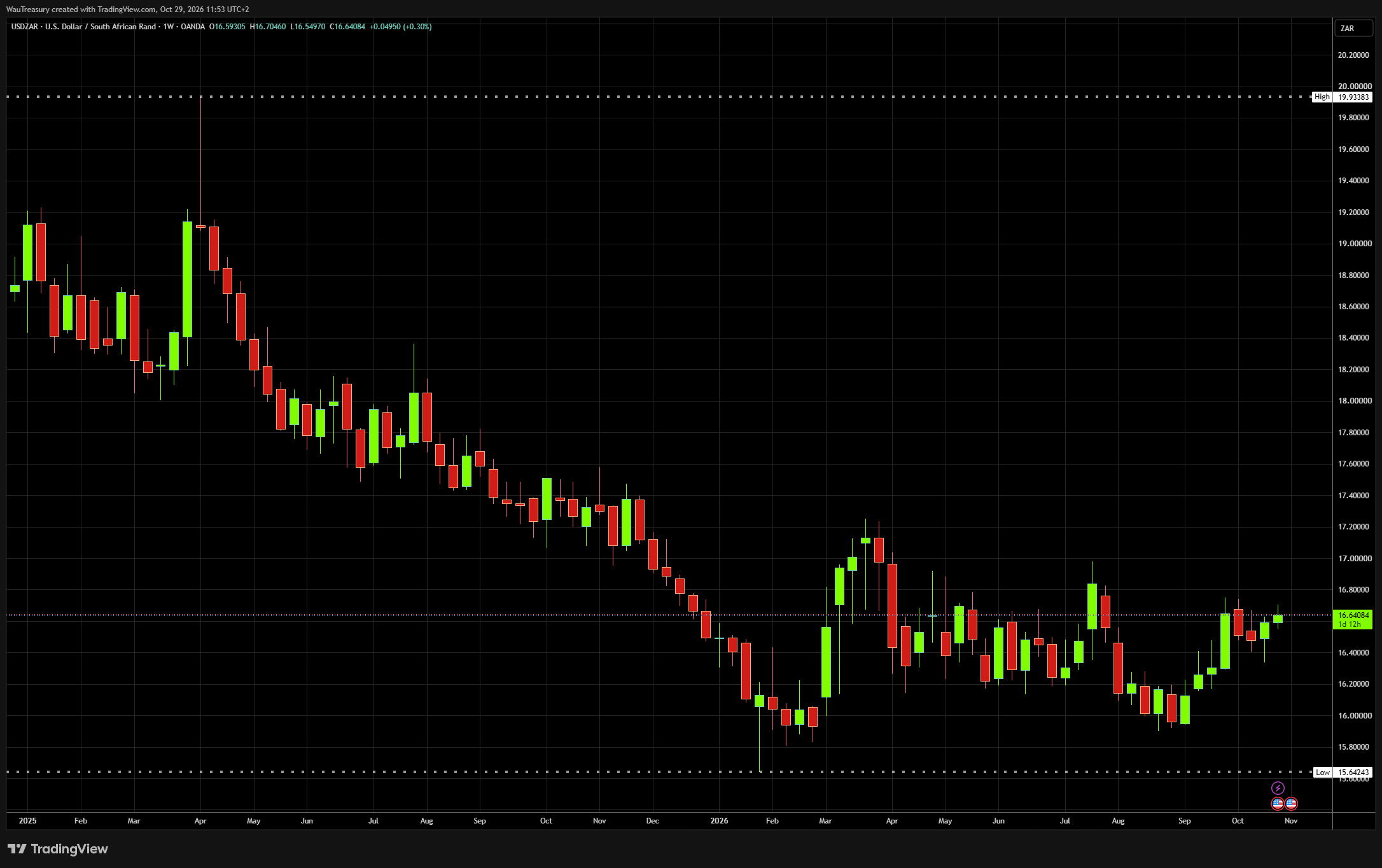
After strengthening from levels above 19.00 against the US dollar in early 2025, the currency briefly traded below 16.00 earlier this year before settling into a relatively narrow trading range. With USD/ZAR currently trading around the 16.60 region, the rand remains considerably stronger than many would have anticipated given the deterioration in global financial conditions.
This raises an important question: Is the rand demonstrating genuine underlying strength, or are financial markets underestimating the risks that could eventually challenge its resilience?
The answer is becoming increasingly important as several of the traditional factors supporting South Africa’s currency begin moving in the opposite direction.
USD/ZAR – WEEKLY | JANUARY 2025 TO OCTOBER 2026
The rand has strengthened considerably since early 2025, remaining relatively resilient despite a more challenging global economic environment.
The Return of Higher Global Interest Rates
One of the most significant developments during 2026 has been the shift in global monetary policy expectations. At the beginning of the year, financial markets were largely positioned for a continuation of monetary easing, with expectations that major central banks would gradually reduce interest rates as inflation moderated. However, persistent inflationary pressures, elevated energy prices and geopolitical tensions have forced policymakers to reconsider their approach.
The US Federal Reserve has been central to this adjustment. Following a 25-basis-point interest rate increase in September, the Fed maintained its policy rate at 3.75%–4.00% during its October meeting on 28 October. Although the decision was widely anticipated, two policymakers voted in favour of a further increase, highlighting the continued concern surrounding inflation.
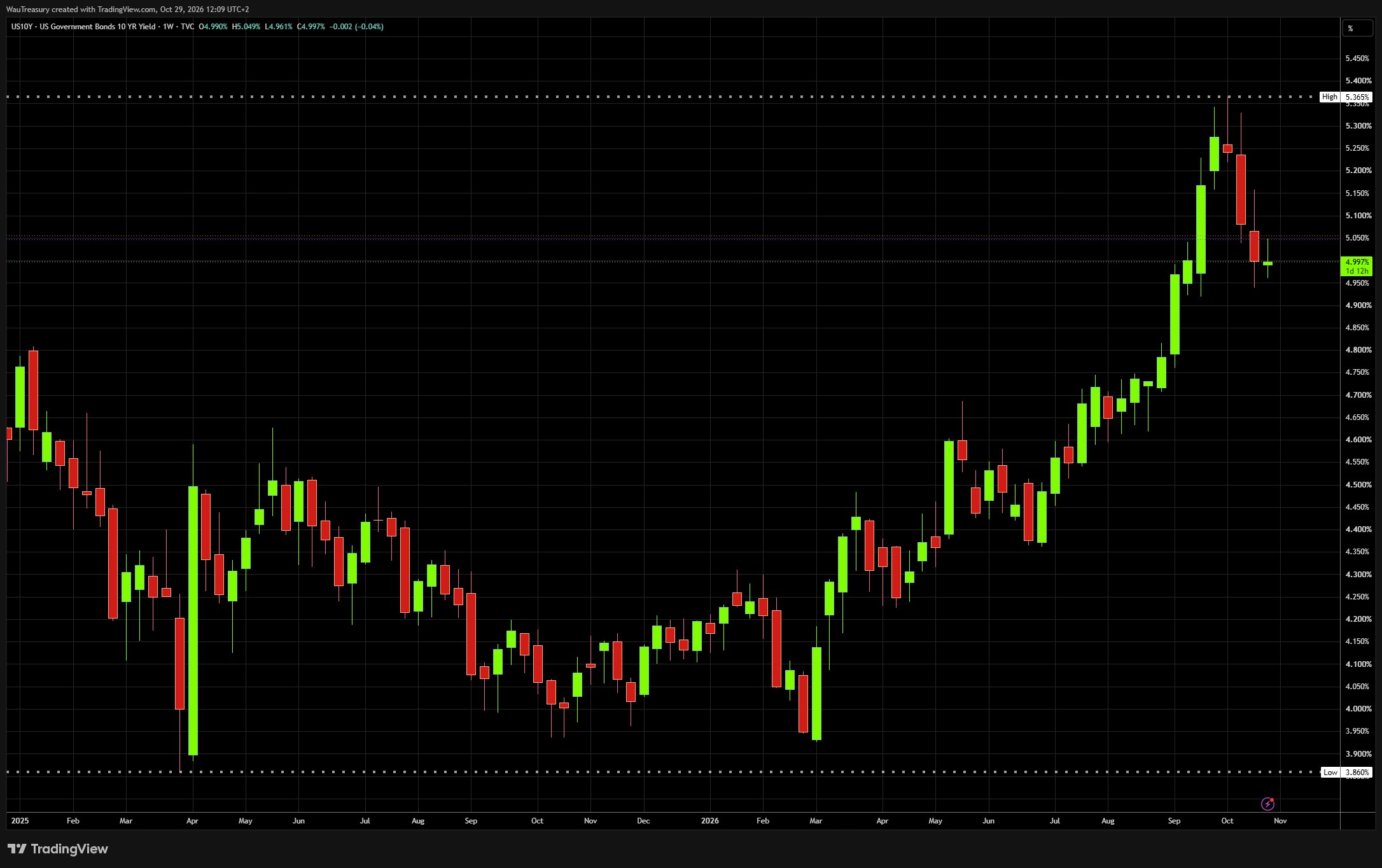
Perhaps more importantly, the US Treasury market has undergone a substantial repricing. The benchmark 10-year Treasury yield has climbed towards 5.05%, compared with approximately 4.00% a year ago.
Higher US yields have important implications for emerging-market currencies. When investors can earn increasingly attractive returns from US government securities, the additional compensation required to hold riskier emerging-market assets generally increases. Historically, this environment has encouraged capital to move towards the United States, supporting the dollar and placing pressure on currencies such as the rand.
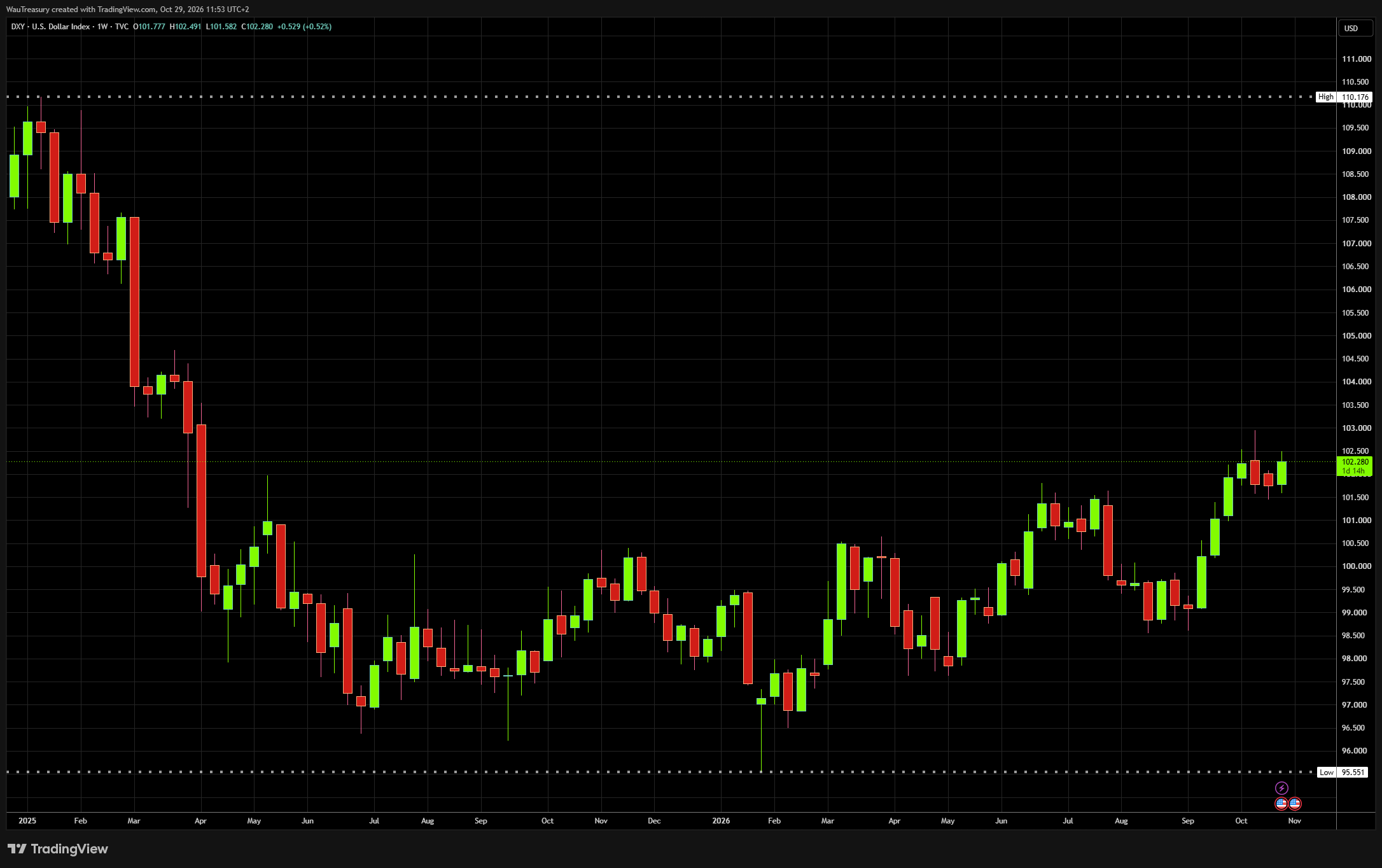
The dollar’s recent performance reflects this shift. After declining towards 97 earlier this year, the US Dollar Index (DXY) has recovered to approximately 102.28. The euro has also weakened considerably, with EUR/USD declining towards 1.1130.
What makes the current environment unusual is that the rand has remained relatively resilient despite the renewed strength in the dollar and the sharp increase in US borrowing costs.
US DOLLAR INDEX (DXY) – WEEKLY | JANUARY 2025 TO OCTOBER 2026
The dollar has strengthened from its February lows, supported by higher Treasury yields and changing monetary policy expectations.
US 10-YEAR TREASURY YIELD | JANUARY 2025 TO OCTOBER 2026
The US 10-year Treasury yield has climbed towards 5.00%, increasing the attractiveness of dollar-denominated investments relative to emerging-market assets.
The Commodity Market Is Sending a Different Signal
South Africa’s currency has historically maintained an important relationship with global commodity markets.
As a major exporter of gold, platinum-group metals and other mineral resources, the country generally benefits from periods of elevated commodity prices. Higher export revenues support the trade balance, improve mining profitability and generate foreign currency inflows, all of which can contribute to a stronger rand. This relationship was particularly evident during the substantial rally in precious metals throughout 2025 and early 2026.
However, the commodity environment has changed considerably. Following an extraordinary rally, gold and platinum have experienced sharp corrections as global interest rate expectations shifted higher and investors reassessed their exposure to precious metals.
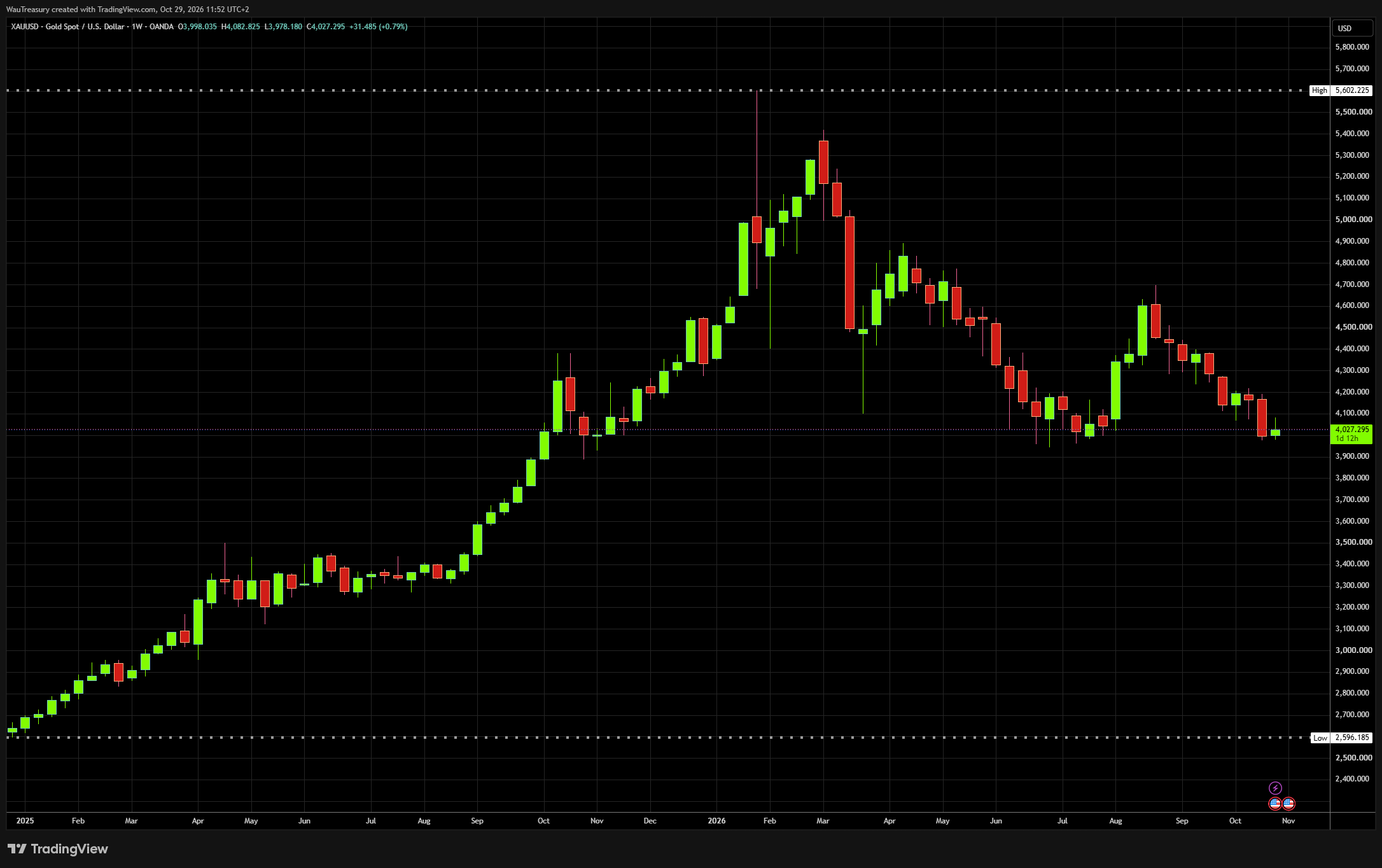
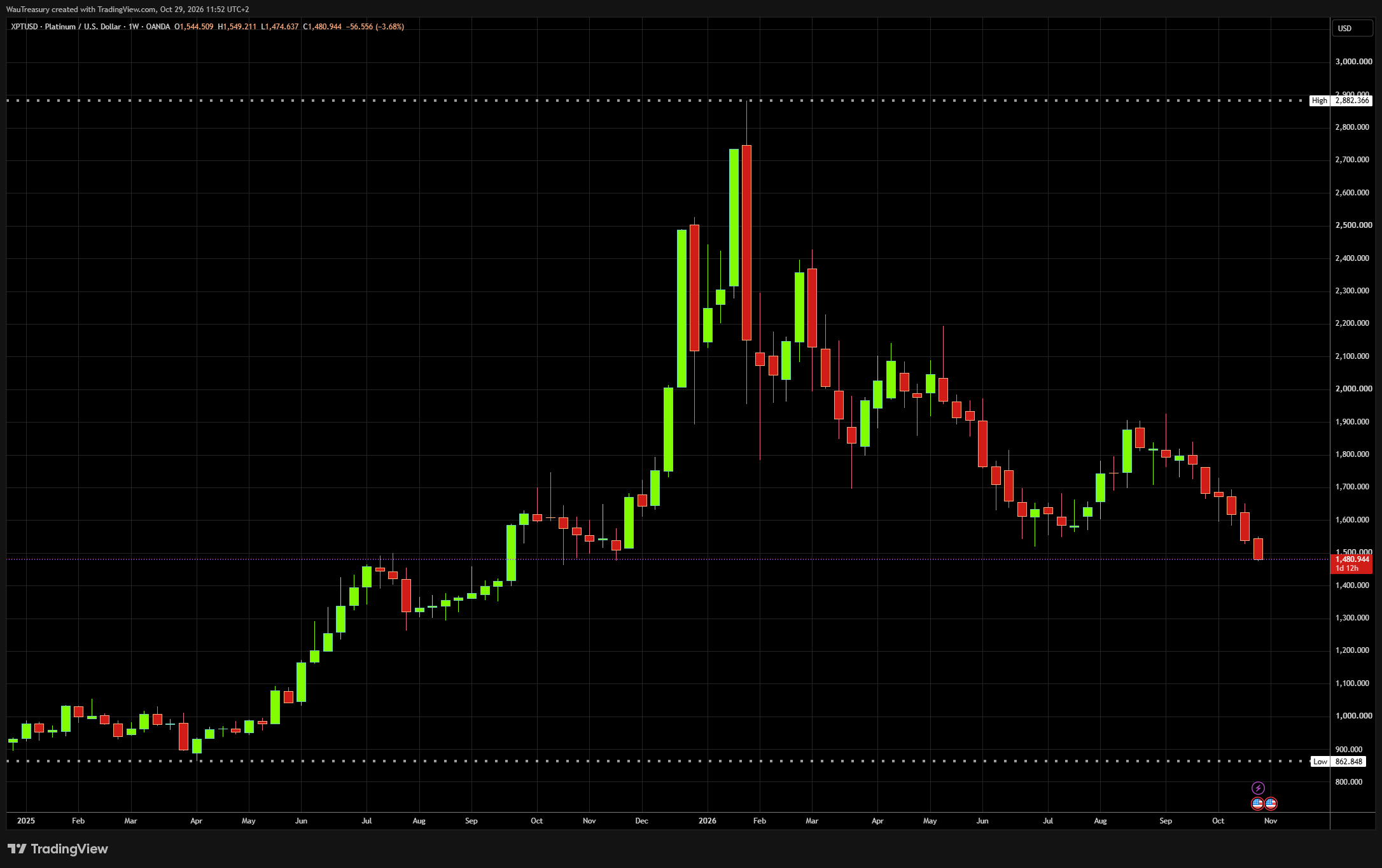
Gold, which traded above US$5,300/oz earlier this year, has declined towards US$4,000/oz. Platinum has experienced an even more pronounced correction, falling from a January peak near US$2,900/oz to approximately US$1,500/oz by late October.
Gold’s correction partly reflects the changing interest rate environment. Unlike interest-bearing investments, gold does not generate an income stream. As real interest rates increase, the opportunity cost of holding precious metals rises, potentially reducing investor demand.
GOLD (XAU/USD) – WEEKLY | JANUARY 2025 TO OCTOBER 2026
Gold has experienced a substantial correction from its earlier highs, although prices remain considerably higher than those recorded at the beginning of 2025.
The platinum market is particularly interesting given South Africa’s significant exposure to the metal. As the world’s largest producer of platinum, South Africa’s mining sector is highly sensitive to changes in international prices.
Platinum has declined by approximately 14% over the past four weeks alone, extending a downward trend that has persisted for much of the year. The correction reflects a combination of weaker investment demand, concerns surrounding global economic growth and a changing outlook for industrial consumption.
According to the World Platinum Investment Council (WPIC), the global platinum market is now expected to record a surplus of approximately 265,000 ounces in 2026, following three consecutive years of substantial deficits.
The revision is particularly significant because it largely reflects investment outflows. Reduced investor exposure, exchange-traded fund liquidations and weaker jewellery demand have contributed to the deterioration in market sentiment.
The WPIC expects automotive demand to decline by approximately 4% this year, although industrial demand is forecast to increase by 5%. This suggests that the decline in platinum prices cannot be attributed entirely to weakening industrial activity, with financial market positioning also playing an important role.
Interestingly, despite the projected surplus, above-ground inventories are expected to provide only approximately 3.4 months of global demand cover by the end of 2026, suggesting that underlying supply conditions remain comparatively tight.
Nevertheless, the direction of platinum prices presents an increasingly difficult environment for South African exporters.
PLATINUM (XPT/USD) – WEEKLY | JANUARY 2025 TO OCTOBER 2026
Platinum has fallen sharply from its January highs, with declining investment demand and weaker automotive consumption contributing to a substantial correction in prices.
For South Africa, the implications extend beyond financial markets. Lower commodity prices can reduce export revenues, weaken mining profitability and diminish an important source of foreign currency inflows. Furthermore, when commodity prices decline in dollars while the rand remains relatively strong, the rand value of export receipts comes under additional pressure.
However, it is important to recognise that precious metal prices remain considerably higher than their levels at the beginning of 2025. South Africa may therefore still be benefiting from the favourable conditions established during the earlier commodity rally.
The more important question is whether the rand can maintain its resilience if commodity prices remain under pressure for another three to six months.
Why Has the Rand Remained So Resilient?
The rand’s continued strength suggests that other factors are helping offset the deterioration in its external environment. One possible explanation is South Africa’s relatively attractive interest rate structure. In September, the South African Reserve Bank increased the repo rate by 25 basis points to 7.25%, bringing cumulative increases since April to 50 basis points. While higher domestic interest rates create challenges for households and businesses, they can also support the currency by making rand-denominated investments attractive to international investors. This is particularly relevant to the carry trade, where investors seek to earn higher returns by holding assets in currencies offering favourable interest rate differentials.
As long as the rand remains relatively stable, investors may continue to find South African fixed-income assets attractive. South Africa has also benefited from improvements in certain domestic fundamentals, while the Reserve Bank’s commitment to its 3% inflation target has reinforced monetary policy credibility. However, attractive interest rates do not eliminate currency risk.
If investors become concerned about exchange rate depreciation, the additional yield offered by South African assets may no longer be sufficient to compensate for that risk.
This creates an interesting dynamic: the rand’s stability may itself be encouraging the capital flows that are helping to sustain its strength. The difficulty is that these flows can reverse relatively quickly when global sentiment changes.
Could the Rand Be Facing a Delayed Adjustment?
Another possibility is that the effects of weaker commodity prices have not yet fully filtered through to South Africa’s external accounts. The substantial commodity rally during 2025 and early 2026 provided an important boost to export revenues. However, changes in international prices do not necessarily translate immediately into movements in the exchange rate.
Export volumes, existing hedging arrangements and the timing of foreign currency conversions can all delay the transmission of lower commodity prices into the domestic foreign exchange market. Consequently, the rand may still be benefiting from some of the favourable conditions established during the earlier commodity boom.
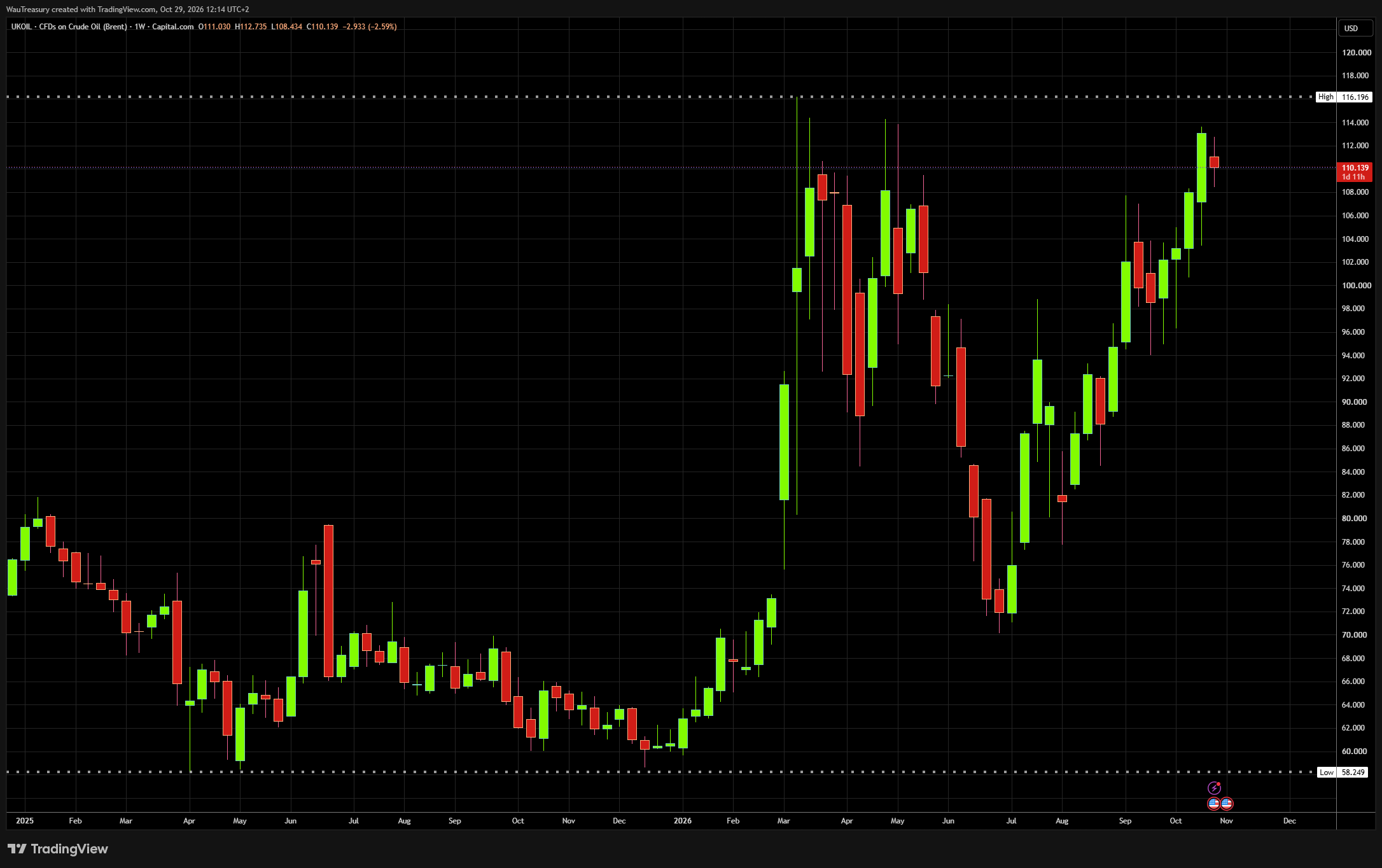
This becomes particularly relevant when considering South Africa’s substantial dependence on imported petroleum. With Brent crude trading around US$110/bbl, the country faces elevated import costs at the same time that important commodity export prices are declining. This combination can place pressure on South Africa’s terms of trade, potentially weakening the trade balance and increasing demand for foreign currency.
The US Midterm Elections and Rising Geopolitical Risks
Adding to the uncertainty is the ongoing conflict between the United States and Iran, which continues to influence global energy markets and investor sentiment. With the US midterm elections scheduled for 3 November, geopolitical developments have become increasingly important for the near-term outlook.
President Trump previously indicated that the United States would refrain from launching further military strikes against Iran before the elections, citing ongoing diplomatic discussions. However, more recent statements have left open the possibility of renewed military action following the vote. Reports also suggest that regional allies have been advised to prepare for a potential escalation and Iranian retaliation, although no final decision regarding further strikes has been announced.
The implications for global financial markets could be substantial. Any renewed military confrontation, particularly one involving energy infrastructure or shipping routes through the Strait of Hormuz, could place further upward pressure on international oil prices. With Brent crude already trading around US$110/bbl, the risk of further supply disruptions remains an important concern.
For South Africa, this creates an additional challenge. As a substantial net importer of petroleum, the country faces elevated import costs at the same time that important commodity export prices are declining. A further increase in oil prices could worsen the country’s terms of trade, increase inflationary pressures and potentially reinforce expectations that global interest rates will remain elevated.
The approaching US elections therefore represent an important source of uncertainty for the rand. While the currency has remained resilient despite deteriorating external conditions, any renewed escalation in the Middle East could test that resilience, particularly if rising oil prices coincide with continued dollar strength and elevated US Treasury yields.
BRENT CRUDE OIL (UKOIL) – WEEKLY | JANUARY 2025 TO OCTOBER 2026
What Does This Mean for the Rand’s Outlook?
Looking ahead, the rand faces a complicated balance of competing influences.
On the positive side, relatively attractive domestic interest rates, continued demand for South African financial assets and monetary policy credibility may help limit depreciation.
However, the external environment is becoming less supportive. A sustained period of elevated US Treasury yields would continue to underpin the dollar, while further weakness in precious metals could gradually reduce South Africa’s export earnings. At the same time, persistently elevated oil prices would increase import costs and complicate the domestic inflation outlook.
From a technical perspective, USD/ZAR continues to trade within a relatively contained range, with the 16.10–16.20 region representing an important area of support.
On the upside, a sustained move above 16.70 could expose the currency to renewed depreciation towards 17.00–17.10.
Conversely, an improvement in global risk sentiment, lower US yields or a recovery in commodity prices could provide renewed support for the rand.
The currency’s resilience should not be interpreted as evidence that the underlying risks have disappeared. Rather, it suggests that favourable financial flows and domestic interest rate attractiveness are currently helping offset a more challenging external environment.
A Strong Rand Is Not Necessarily a Safe Rand
For South African businesses, the distinction between currency strength and currency stability is particularly important. Importers may view the rand’s resilience as an opportunity to secure foreign currency at relatively attractive levels. Exporters, meanwhile, may be tempted to delay entering FEC positions in anticipation of an eventual weakening of the exchange rate.
However, both approaches introduce unnecessary uncertainty when decisions are driven primarily by expectations of where the currency might trade next.
The current environment demonstrates how quickly the factors influencing exchange rates can change. Interest rates, commodity prices and international capital flows are all evolving, and the rand’s relatively calm performance should not encourage complacency. A disciplined foreign exchange strategy should therefore focus on managing exposure rather than attempting to identify the perfect exchange rate.
The rand has shown that it can remain stronger than expected for longer than traditional fundamentals might suggest. However, resilience should never be mistaken for immunity.
As global financial conditions become increasingly challenging, the question is no longer simply why the rand remains strong. It is whether the factors supporting that strength will prove durable enough to withstand the next adjustment in global markets.
