
The Curve Behind the Currency | Why Rising Global Bond Yields Matter for the Rand
Introduction
Bond markets rarely attract the same attention as currencies, commodities or equities, but they often provide some of the clearest signals about how investors are pricing growth, inflation and risk.
That has become particularly important in 2026.
US Treasury yields have moved sharply higher across the curve, while South African government bond yields have also repriced. At the same time, the dollar has strengthened, oil markets have remained volatile and USD/ZAR has moved back towards the upper end of its recent range at around 16.40.
The US 10-year Treasury yield recently moved above 5.25%, reaching levels last seen in 2007, while the 2-year has moved close to 5%. The Federal Reserve also raised the federal funds target range by 25 basis points in September to 3.75%–4.00%, noting that economic activity remained solid and inflation elevated.
For the rand, this matters because the currency does not respond only to South African developments. It also reflects the relative return available on dollar assets, changing global risk appetite and the premium investors demand for taking emerging-market risk.
The important question is therefore not simply whether yields are rising, but why they are rising, where they are rising fastest and what that means for the relative attractiveness of the rand.
Getting Up to Speed
Last month, we looked at how changing expectations around the Federal Reserve were influencing the dollar and short-term Treasury yields.
Since then, the picture has become broader. The Fed has now raised rates, US yields have continued higher and the move is no longer confined to the front end of the curve. Longer-dated Treasury yields have also risen sharply, suggesting that markets are pricing more than just another interest-rate increase.
At the same time, oil prices and geopolitical uncertainty have returned as major inflation risks. The SARB has also raised its policy rate by 25 basis points to 7.25%, citing renewed fuel-price pressure, higher global rates and upside inflation risks.
This creates a very different environment from one in which only central-bank policy is moving markets.
The current repricing reflects a combination of monetary policy, inflation, geopolitical risk and concerns around the longer-term sustainability of government borrowing.
What Has Happened to the US Yield Curve?
US TREASURY YIELD CURVE – JANUARY 2026 TO SEPTEMBER 2026
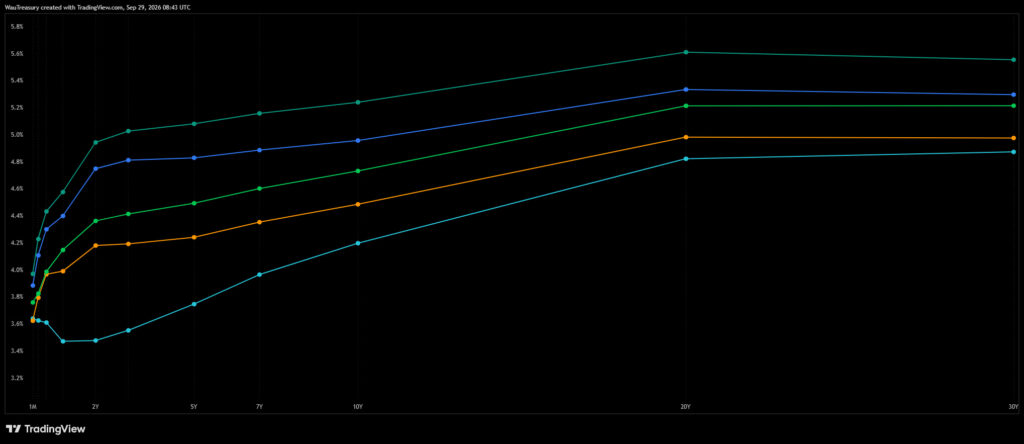

The US yield curve has shifted materially higher during 2026.
At the beginning of the year, the US 2-year yield was around 3.475%, while the 10-year was near 4.195%. By late September, the 2-year was approaching 5% and the 10-year had moved above 5.2%, with the 20- and 30-year yields also trading comfortably above 5%.
This has attracted considerable attention across global markets. US Treasury yields are effectively a benchmark for the global financial system, influencing everything from corporate borrowing costs and equity valuations to currency markets and the relative attractiveness of emerging-market assets.
The important point, however, is that different parts of the curve are telling us different things.
Short-dated yields are heavily influenced by expectations for Federal Reserve policy. When the 2-year yield rises sharply, markets are generally signalling that they expect policy rates to remain higher for longer, or that further tightening may still be required.
Longer-term yields tell a broader story. The 10-, 20- and 30-year portions of the curve reflect not only expectations for future interest rates, but also longer-term inflation expectations, economic growth, government borrowing requirements and the additional return investors demand for holding debt over an extended period.
This is particularly relevant in the current environment. The increase in long-term US yields has occurred against a backdrop of persistent inflation concerns, elevated government borrowing, volatile energy prices and considerable uncertainty around the global economic and geopolitical outlook.
Investors are therefore not simply asking “what will the Fed do next?” They are also asking “what return do I require to lend to the US government for the next 10, 20 or 30 years?”
The additional compensation investors require for taking that longer-term uncertainty is commonly referred to as the term premium.
When that premium rises, long-term Treasury yields can move higher even if expectations for the Fed itself have not changed.
Why the Long End Matters
It would be easy to assume that the rise in Treasury yields is simply the result of the Fed becoming more hawkish. That explains only part of the move. The US 10-year yield briefly reached around 5.27% this week, while the 30-year approached 5.55%. These moves have occurred alongside concerns around inflation, high energy prices, strong economic activity and rising US government debt.
That matters because a rise in longer-dated yields can tighten financial conditions even if the Fed does nothing. Higher long-term yields increase borrowing costs for companies and households, raise discount rates used to value equities and make government bonds more competitive relative to riskier assets.
In practical terms, investors can now earn more than 5% on parts of the US Treasury curve without taking rand currency exposure. That raises the hurdle rate for emerging markets.
For South Africa, the key issue is therefore not whether local bond yields are high in absolute terms. It is whether they remain sufficiently attractive relative to the US.
When Geopolitics Reaches the Bond Market
The recent rise in US yields is also increasingly connected to what is happening outside traditional economic data.
The US-Iran conflict and uncertainty around the Strait of Hormuz have kept energy prices volatile. Brent remains elevated, while investors continue to react to changing signals around negotiations and the outlook for oil supply.
The transmission into bond markets is relatively straightforward. Higher oil prices can raise inflation expectations. Higher inflation expectations can increase the probability that central banks keep interest rates restrictive for longer. That can push Treasury yields higher. Higher Treasury yields can then support the dollar and weigh on risk-sensitive assets.
The result is that one geopolitical headline can move several markets almost simultaneously.
Oil, bond yields, the dollar and the rand can all react to the same shift in sentiment, even when nothing has significantly changed in South Africa.
This is also where policy uncertainty becomes relevant. Markets are having to respond not only to economic releases, but also to rapidly changing statements around tariffs, sanctions, energy policy and the Middle East.
The issue is not whether every statement proves correct. The issue is that uncertainty itself can carry a price.
When investors are less certain about future inflation, government borrowing or policy direction, they may demand more compensation to hold long-dated bonds. That can keep the long end of the US curve elevated even if the Fed pauses.
What Is Happening to the South African Curve?
SOUTH AFRICAN GOVERNMENT YIELD CURVE – JANUARY TO SEPTEMBER 2026


South African government bond yields have also moved higher this year. The most noticeable change has occurred across the middle of the curve. The 5-year yield has risen materially, while the 10-year has moved from around 8.24% at the beginning of the year to just above 9.0% by late September. Longer-dated yields remain elevated, with the 20-year portion of the curve above 9.5%.
At first glance, this may appear supportive for the rand. Higher domestic yields increase the potential return available to investors holding rand-denominated assets. But the important comparison is not South Africa today versus South Africa six months ago.
It is South Africa versus the alternatives available globally.
At the beginning of the year, the South African 10-year government bond yielded roughly 8.240%, compared with approximately 4.195% on the US 10-year. That represented a spread of 4.045%.
By late September, the South African 10-year had increased to roughly 9.04%, but the US equivalent had risen even faster to above 5.243%. The yield advantage has therefore narrowed slightly to 3.797%.
A 9% South African government bond yield may look attractive in isolation. It looks different when a US Treasury offers more than 5% without rand currency exposure.
The Yield Spread Matters More Than the Yield Itself
This is one of the most important points when considering the relationship between bond markets and the rand.
Global investors do not simply ask: “What does South Africa yield?”
They ask: “What additional return am I receiving for taking South African risk?”
That additional return needs to compensate for currency volatility, liquidity risk, inflation uncertainty and broader emerging-market risk. If US yields rise faster than South African yields, the relative advantage of holding rand assets narrows. That can reduce the attractiveness of emerging-market carry.
But there is another distinction. Higher South African yields are not automatically positive for the currency. If yields rise because growth prospects improve and inflation remains well controlled, the additional return may attract capital. If they rise because investors are worried about inflation, fiscal pressure, currency weakness or imported energy costs, the higher yield may simply represent compensation for greater risk.
Not all yield is created equal.
The same principle applies to the US. Higher yields driven by strong growth can support the dollar for different reasons than higher yields driven by fiscal or inflation concerns. The underlying reason for the move remains critical.
What Does This Mean for the Dollar?
The current environment has been broadly supportive of the dollar. US yields have risen across the curve and the Fed has returned to tightening, while elevated energy prices have complicated the inflation outlook. This has helped keep the DXY above 101 and close to recent multi-month highs.
The mechanism is relatively straightforward. If an investor can earn a higher return on dollar-denominated assets, demand for those assets can increase. That can support the dollar. At the same time, higher US yields can weigh on global equities and broader risk appetite, which can create another source of support for the dollar through safe-haven demand. However, as with bond yields, the reason behind dollar strength matters.
A dollar supported by strong US growth and attractive yields is different from a dollar supported primarily by global risk aversion.
Both can ultimately weigh on the rand, although the transmission occurs through different channels.
What Does This Mean for the Rand?
USD/ZAR MONTHLY PERFORMANCE – DECEMBER 2025 TO SEPTEMBER 2026

USD/ZAR has reflected just how quickly the broader market environment has changed this year.
The rand strengthened through December, January and February, with USD/ZAR declining by 3.28%, 2.69% and 1.14% respectively. The USD/ZAR touched its lowest level late in February 2026 at a modest level of 15.64.
March saw a sharp reversal, with USD/ZAR moving by an eye-watering 5.11% and briefly reaching a year-to-date high of 17.25.
Since then, movements have been more two-way. April declined 1.73%, May 2.74%, June rose 0.98%, July increased 1.01%, August declined 2.12% and September has risen approximately 1.77% thus far.
September is particularly useful when viewed alongside the yield curves. USD/ZAR has weakened during the month at the same time as US yields have moved sharply higher. This obviously does not mean Treasury yields are the only reason. Oil prices, precious metals, geopolitical risk and domestic developments have all played a role.
But it does illustrate the pull-through from global rates into the currency. Higher US yields make dollar assets more competitive. That consequently raises the hurdle rate for emerging-market assets. If South African yields do not rise by the same amount, the relative return advantage narrows. Capital flows can become less supportive. And USD/ZAR can move higher even when there has been no equivalent deterioration in domestic fundamentals.
The rand does not only react to South African news. It also reacts to the return global investors can earn by choosing not to hold rand assets.
Three Possible Outcomes
There are several ways the current environment could evolve.
If US inflation and employment data begin to soften, expectations for further Fed tightening could ease. Short-term Treasury yields would likely fall, the dollar could lose some support and the relative environment for the rand could improve.
If US growth remains resilient while inflation stays elevated, Treasury yields could remain high across the curve. The dollar would retain support and the hurdle rate for emerging-market assets would remain elevated.
The most difficult scenario would be persistent inflation combined with continued fiscal and geopolitical uncertainty. In that environment, long-dated Treasury yields could remain high even without aggressive additional Fed tightening. Global financial conditions would stay restrictive and the rand could remain sensitive to shifts in oil, risk sentiment and capital flows.
The upcoming US midterm elections on 3 November add another layer of uncertainty. All 435 seats in the House of Representatives and roughly one-third of the Senate are up for election, meaning the result could alter the balance of power in Congress and influence how easily the administration can advance future fiscal, tax and spending measures.
For bond markets, the key issue is not which party performs better, but whether the election outcome changes expectations around government spending, borrowing requirements, deficits and Treasury issuance. Any significant reassessment of those factors could affect the term premium and place additional pressure on longer-dated yields.
The midterms also arrive at a time when markets are already reacting quickly to changes in trade, sanctions, energy and Middle East policy. This means political developments could become another source of volatility for the Treasury market, the dollar and, indirectly, the rand.
There is no certainty around which scenario will dominate. That is precisely what the shape of the yield curve is helping markets assess: not only the next Fed move, but the broader balance between inflation, growth, fiscal policy and uncertainty.
The Bottom Line
The rise in global bond yields is no longer simply a story about the next Federal Reserve meeting, and the ZAR’s performance is not just based on the SARB’s next interest rate decision.
The short end of the US curve reflects expectations for monetary policy and the possibility that interest rates remain restrictive for longer. The long end tells a broader story, incorporating inflation expectations, economic growth, fiscal risk, government borrowing requirements and the additional compensation investors demand for uncertainty.
At the same time, South African yields have also risen, but not enough to prevent the relative yield advantage over the US from narrowing across parts of the curve.
That matters for the rand. Higher US yields increase the return investors can earn on dollar-denominated assets without taking emerging-market currency risk. As that relative yield advantage narrows, rand assets can become less attractive at the margin. When this occurs alongside volatile oil prices, geopolitical uncertainty and a stronger dollar, USD/ZAR can come under pressure even when South African fundamentals have not deteriorated materially.
The coming months could remain particularly sensitive. Markets are simultaneously assessing the path of US inflation and interest rates, uncertainty surrounding the Middle East and energy markets, concerns around government borrowing and fiscal sustainability, and the potential policy implications of the November US midterm elections.
Bond markets therefore provide important context for understanding movements in the currency.
The key question is not simply whether South African yields are high, but whether the additional return remains sufficient relative to the return and risk available elsewhere.
With global rates, energy prices, fiscal concerns and policy uncertainty all shifting rapidly, the yield curve may remain one of the clearest indicators of how global investors are repricing risk — and, by extension, one of the most important external signals for the rand.
