
Metals Meltdown: The Shockwave That Drove the Rand Weaker and Dollar Stronger
The rand enters the new month on the defensive after one of the most dramatic episodes in precious-metals trading in more than a decade, an event that flipped global risk sentiment and reignited broad US dollar strength. The sequence was abrupt and disorderly.
Gold, which had traded as high as USD 5 598/oz on 29 January, collapsed over the following sessions to an intraday low of USD 4 402/oz by 2 February – a decline of roughly 21% in just three trading days.
Silver suffered an even more violent move from a peak of around USD 121/oz, it plunged to USD 71/oz, marking an extraordinary 40% peak-to-trough collapse as forced deleveraging and extreme margin-driven selling tore through the market.
Platinum also experienced a severe unwind, falling from highs near USD 2 814/oz to a low around USD 1 893/oz, a drawdown of roughly 33%. These price shocks were amplified by cascading margin calls, systematic selling and disorderly liquidations in China’s leveraged retail-metals products, overwhelming available liquidity and erasing the commodity tailwind that had supported the rand throughout January.
As metals capitulated and global markets simultaneously shifted toward a more cautious interpretation of future US liquidity conditions, USD/ZAR climbed to briefly touch 16.30 on Monday morning, while EUR/ZAR and GBP/ZAR tracked higher as the broader risk-off environment deepened.
The global backdrop darkened sharply as precious metals unwound. South Africa’s deep linkages to gold, platinum and silver mean that such a rapid collapse hits the currency through both the terms-of-trade channel and investor sentiment. The rand’s long-standing correlation with its export commodities is well known, and when the commodity floor gives way in a disorderly fashion, the exchange rate tends to follow.
Importantly, the domestic economy is not at fault. South Africa posted a budget surplus, a trade surplus and healthy credit extension last week – all of which would normally provide a supportive backdrop for the rand. That said, in a week like this one, external conditions dominated; global liquidity expectations, metals volatility and the trajectory of the dollar carried far more weight than local data.
What made this episode particularly impactful is that it collided with a shift in the US Federal Reserve narrative. The announcement that President Trump intends to nominate Kevin Warsh as the next Fed Chair triggered a repricing in US monetary-policy expectations. Warsh’s past scepticism toward quantitative easing, and his preference for a more orthodox balance-sheet structure, led markets to infer a greater risk of liquidity tightening ahead. This did not meaningfully alter policy-rate expectations but did tighten the liquidity premium priced into the dollar, helping the USD push higher just as emerging markets were absorbing the shock from collapsing commodities.
This is where BCA Research’s most recent Foreign Exchange Strategy report provides essential context. Their work shows that the dollar’s movement in recent weeks has been shaped far more by policy headlines than by fundamentals. They note that the intensity of the recent USD price action cannot be explained by changes in real-yield differentials or incoming data, with US growth expectations for 2026 actually being revised higher relative to the rest of the world. In other words, the dollar strengthened not because macro fundamentals suddenly improved, but because markets reacted violently to trade rhetoric, geopolitical messaging and perceived shifts in policy. BCA emphasises that such moves can reverse just as quickly as they emerge, precisely because they are not rooted in deeper structural change.
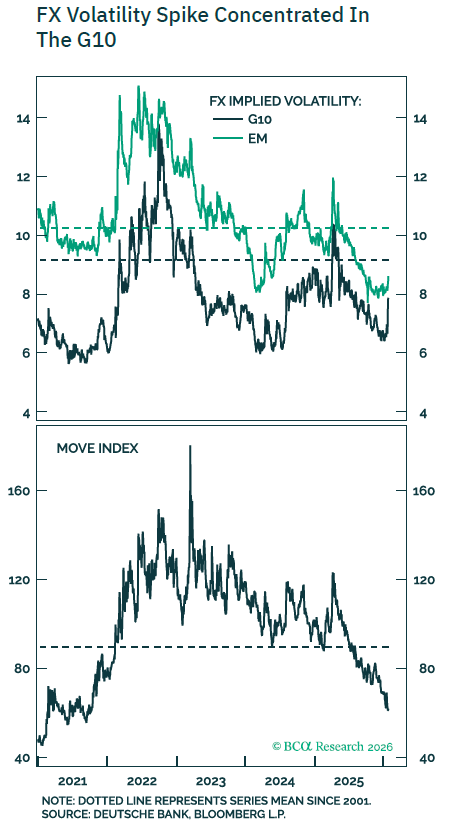
BCA also highlights that the volatility spike was initially concentrated in the G10 space, especially around the yen, where expectations of official intervention surged after reports of a USD/JPY rate check by the New York Fed. Although South Africa was not at the centre of these developments, the risk-off spillover was inevitable. With commodity markets in freefall, the rand was pulled into the global unwind, even though EM FX more broadly had been relatively muted earlier in the month. This interplay between G10 policy shocks and EM commodity exposure is precisely why the rand behaved more violently once the metals sold off.
Central to BCA’s assessment is the role of momentum in USD cycles. Historically, the dollar tends to behave like a momentum currency: once it begins a substantive depreciation or appreciation phase, the trend often extends beyond the initial catalyst. BCA points out that after a year of dollar weakness, subsequent years often see further softness; however, this only becomes a durable trend once the dollar breaks below key long-term technical thresholds. In their framework, the crucial line in the sand is the DXY 95 level, below which they would initiate a structural short-dollar stance. For now, the market remains above this threshold, which implies that recent USD swings are still best viewed as tactical volatility rather than structural change. That distinction matters enormously for how South African treasurers frame their hedging strategies.
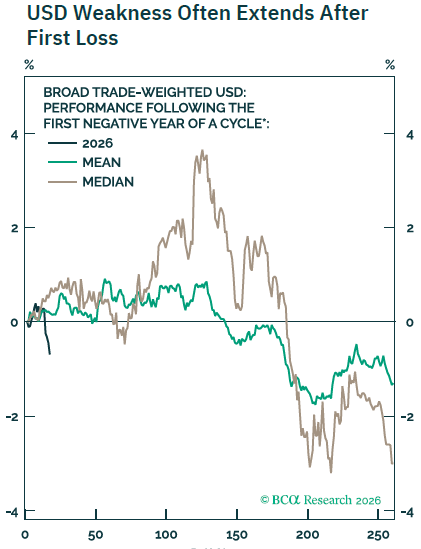
Even though BCA’s longer-term stance leans toward a weaker dollar, the report stresses that the recent sell-off was driven by “idiosyncratic, policy-driven dynamics” rather than deterioration in the fundamental backdrop for the USD. For South Africa, this means that the rand remains vulnerable to external shocks, especially while precious metals search for a stable base. Stabilisation in these markets will likely require some combination of lower margin pressure, a halt to systematic selling and renewed physical demand – potentially from central banks. Until such stabilisation emerges, rallies in the rand should be approached cautiously, with a preference for disciplined hedging rather than opportunistic timing.
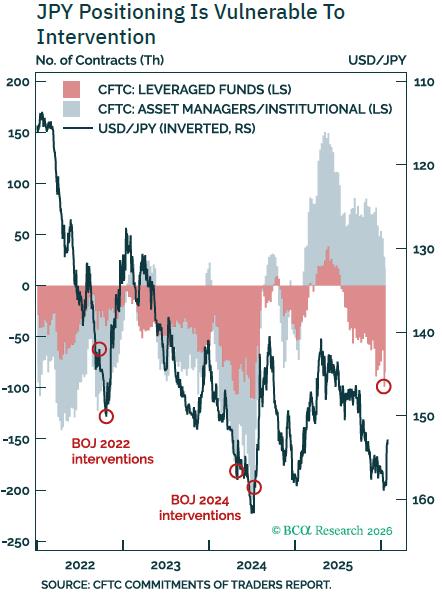
Additionally, the risk of yen intervention remains a wildcard. BCA places the probability of near-term intervention above 50%, noting that Japanese officials have followed similar patterns in past episodes and that leveraged JPY short positions are currently exposed. Whether the Bank of Japan intervenes or not will influence global dollar dynamics and risk appetite. If intervention occurs, it could tighten global financial conditions temporarily, while the absence of action could shift focus back to Japan’s fiscal dynamics and potentially weaken the yen again. Both outcomes have implications for USD liquidity, and by extension, emerging-market currencies such as the rand.
The intersection of all these forces – commodity turmoil, shifting liquidity expectations, heightened G10 volatility, intervention risk in the yen and resurgent dollar momentum – underscores the importance of structured FX management rather than reactive trading. Importers should take advantage of rand strength when it presents itself, particularly during dips toward the lower end of the 16.00 range, using forward cover to reduce timing risk and protect costed levels. For exporters, the recent depreciation of the rand against the majors may appear attractive, but the broader medium- to long-term trend has still favoured a stronger currency. It is therefore more prudent to capitalise on current levels through disciplined hedging than to wait in the hope of even more favourable rates. Proactive strategies are far more effective than relying on the rand to break materially weaker from its strengthening trajectory. Ultimately, a more convincing shift in the fundamental backdrop – especially in the commodity complex, which remains elevated despite the recent correction – will be required before the rand can sustainably push higher.
In the weeks ahead, all eyes will be on the metals microstructure, global-liquidity guidance from the incoming Fed leadership, and any signs of a stabilisation in overall risk sentiment. If metals find a durable floor and US policy rhetoric cools, the rand has room to recover from the extremes seen after the commodities rout. But as long as liquidity conditions remain uncertain and dollar momentum stays resilient, the currency is likely to trade with a cautious tone. This month’s events serve as a reminder of the rand’s sensitivity to global shocks, particularly when they intersect with South Africa’s export profile. A structured, pre-planned hedging approach remains the most reliable way to navigate such volatility, ensuring that corporate treasury decisions are anchored in discipline rather than dictated by fast-moving headlines.
For deeper insights and tailored risk‑management solutions, contact David du Plessis at dduplessis@wauko.com, Evan May at emay@wauko.com or Karel van Niekerk at kvanniekerk@wauko.com.


