
The SA Budget Bounce Meets Global De-Leveraging: Navigating the Rand Through Middle East Escalation
The Start of 2026 Split into Two Halves
For South African markets, February was poised to go down as a textbook example of how credible fiscal signalling can systematically dismantle sovereign risk premia. The National Budget delivered a masterclass in consolidation, sending the rand to a firm R15.85 against the dollar in the immediate aftermath.
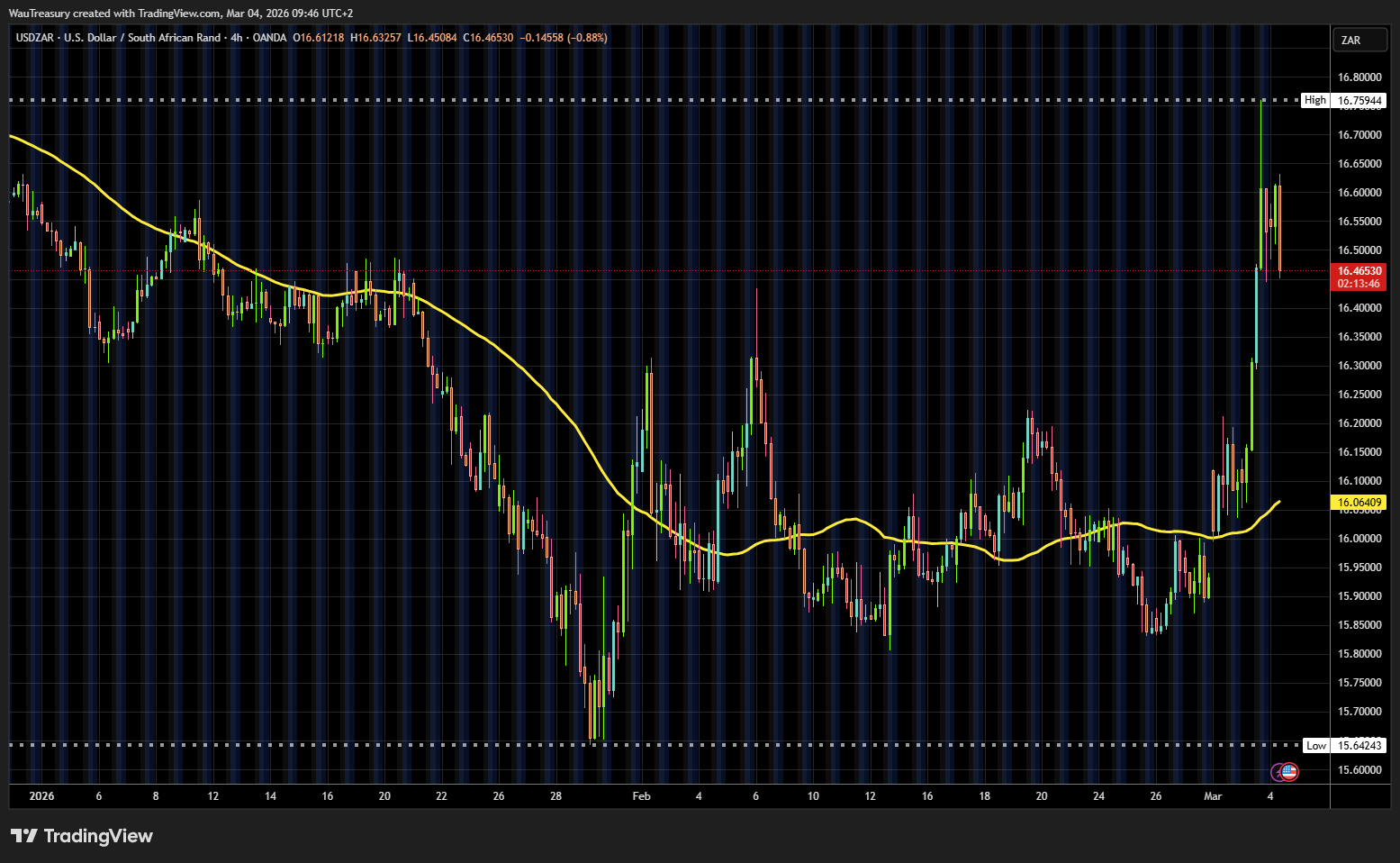
Yet, as we transition into March, the narrative has violently shifted, whipsawing markets and erasing February’s domestic optimism. The escalating conflict following “Operation Epic Fury” – the coordinated US and Israeli military offensive that reportedly resulted in the death of Iranian Supreme Leader Khamenei – has abruptly redrawn the global risk map, injecting a massive dose of exogenous volatility into currency markets, most notably impacting EM currencies like the rand. By the morning of 4 March, the USD/ZAR was trading aggressively in the 16.40 – 16.75 range, buckling under a disorderly de-leveraging event and a massive capital flight into the unmatched liquidity of the US dollar.
For corporate treasurers and forex hedgers, the abrupt shift from domestic optimism to structural exogenous volatility demands an immediate pivot toward disciplined risk management. Relying on pre-crisis baseline assumptions is no longer sufficient; successfully navigating this global shock requires strict adherence to formalised foreign exchange policies to actively control exposure.
The Baseline: A Credible Fiscal Buffer
Before addressing the Middle East, we must anchor our assessments in the domestic reality, which has fundamentally improved. Finance Minister Enoch Godongwana’s Budget 2026 was widely lauded as a vital turning point. The consolidated budget deficit is projected to narrow to 4.5% of GDP for 2025/26, with gross debt projected to stabilise at 78.9% of GDP.
This inflection point marks the first credible halt to debt accumulation since the global financial crisis. As this geopolitical storm unfolds, South Africa’s macroeconomic fundamentals initially offered a favourable degree of shock absorption. However, the rand is now trading in tandem with other high-beta emerging market currencies, buckling under a massive structural rotation. While the local unit typically relies on a correlation with precious metals (gold, platinum, iron ore) during times of crisis, this historical buffer fractured violently on 3 March.
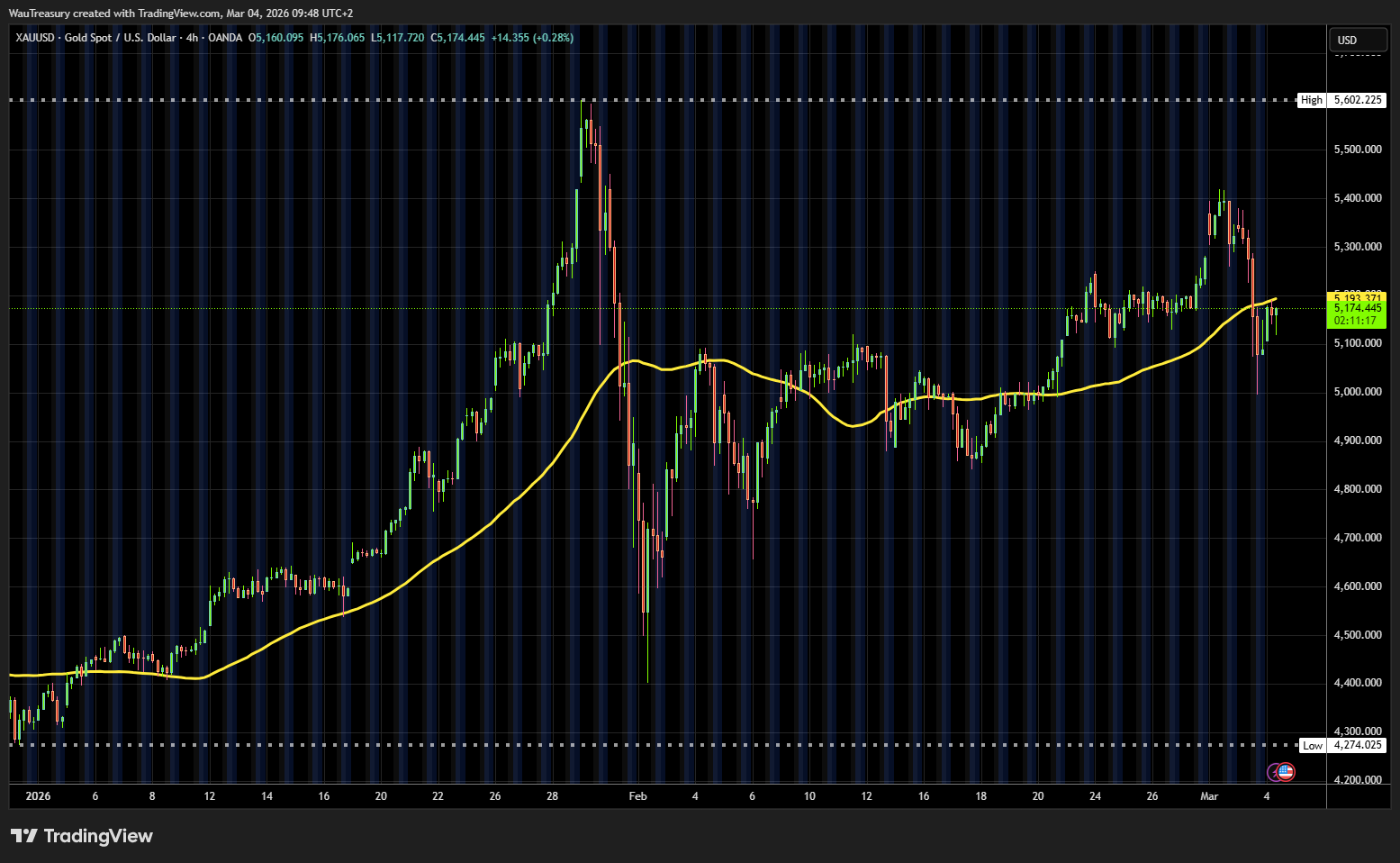
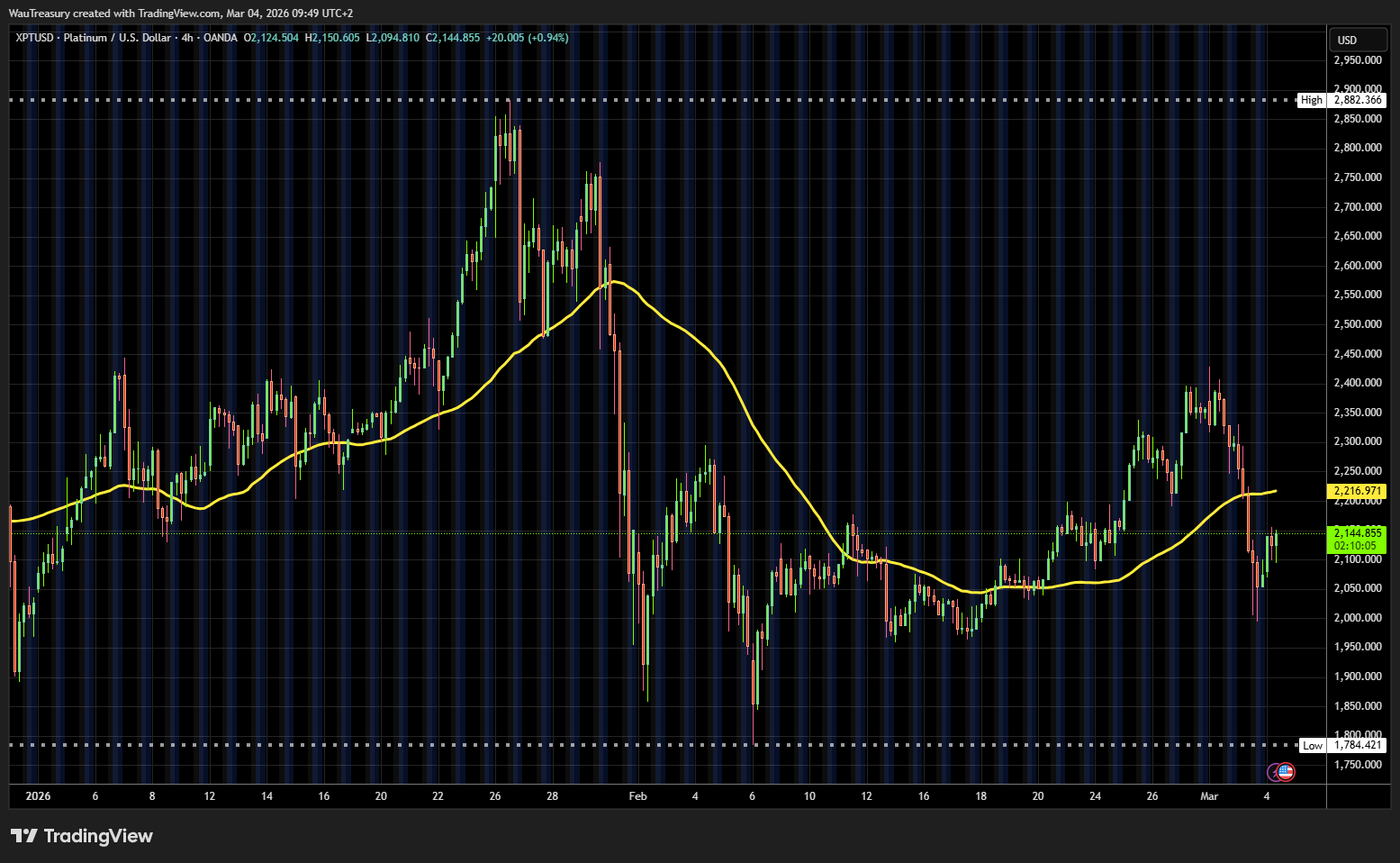
A severe, liquidity-driven “sell what you can” phase to cover margin calls saw gold slump heavily towards the USD 5,000 an ounce mark, while platinum dropped roughly 10% to touch a low of USD 2,000 an ounce, before the complex caught a modest safe-haven bid on Wednesday morning.
The Geopolitical Pivot: The Fate of Risk-On Assets
The key factor driving the rand at the moment is the broader capitulation of global risk-on assets. The sudden, open-ended escalation in the Middle East has fundamentally altered capital flows.
We are seeing a brutal risk-off environment, highlighted by severe offshore weakness as European equities suffered their worst trading session since April of last year, while the S&P 500 and broader Wall Street indices remain under heavy pressure as investors brace for a prolonged energy shock.
Capital is aggressively rotating into the US dollar. The US Dollar Index (DXY) has surged for three consecutive days to near 99.60, reaching its strongest level since late November. The fundamental improvements outlined in the National Budget act as a vital parachute, but they cannot entirely stop the gravitational pull of this massive flight to safety.
Compounding this geopolitical anxiety is a growing public rift between Washington and its traditional European allies, highlighted by President Trump taking rhetorical shots at Spain and sharply criticizing UK Prime Minister Keir Starmer following disagreements over the Iran strikes.
Beyond the Dollar: Cross-Rate Resilience
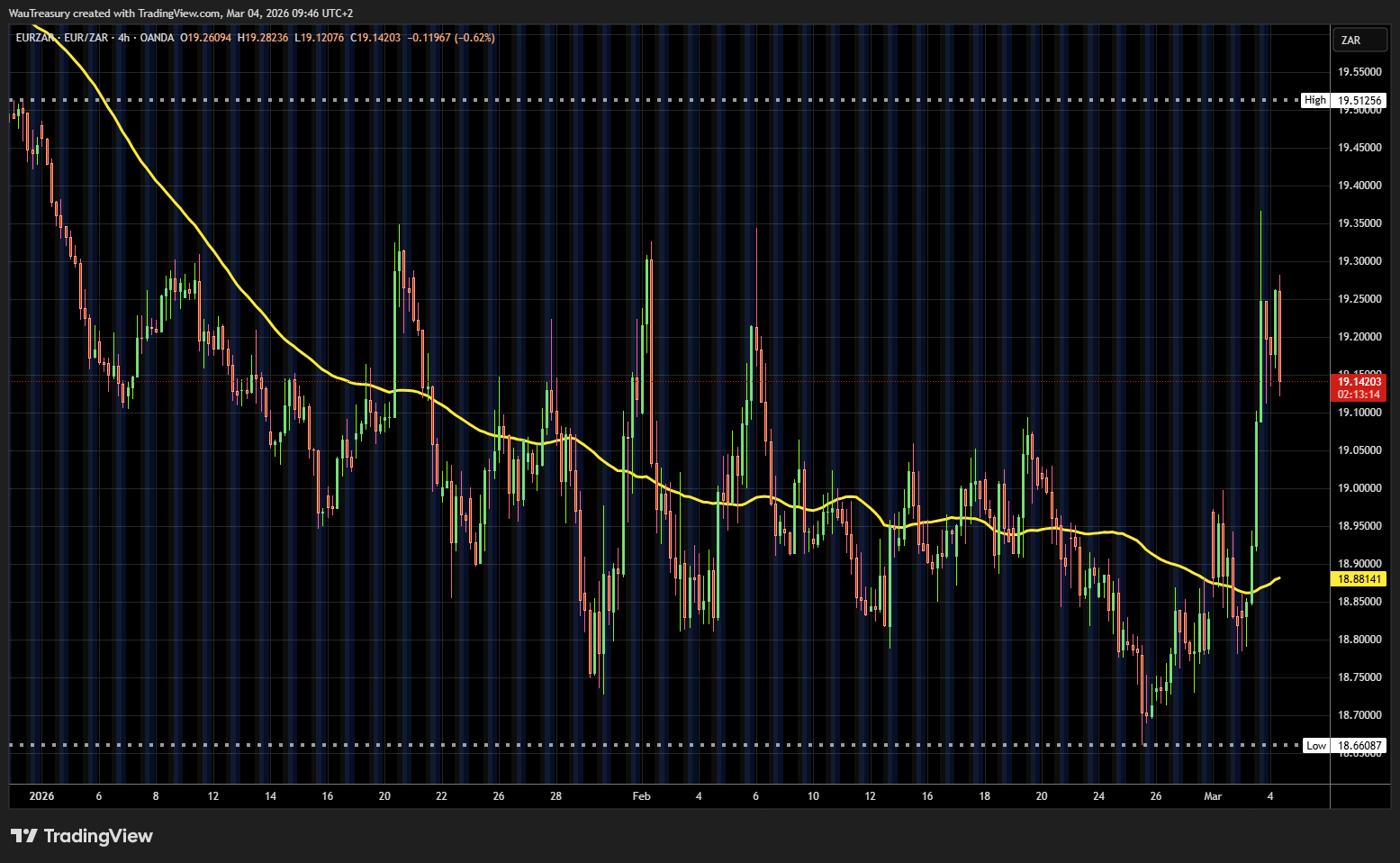
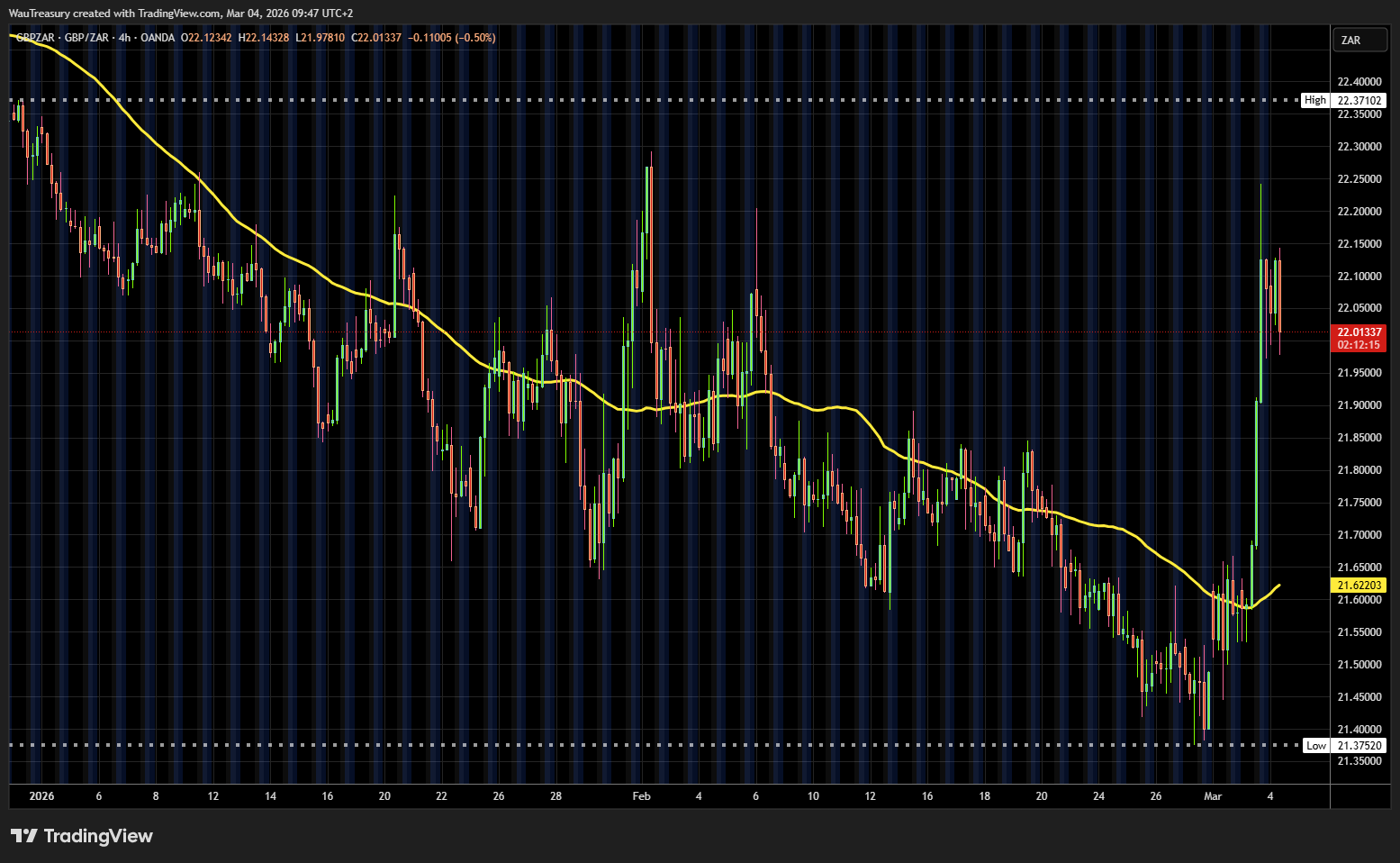
While the USD/ZAR dominates headlines due to the greenback’s absolute dominance, treasurers must closely monitor the cross-rates. Europe and the UK are acutely exposed to Middle East energy shocks, meaning the euro and sterling do not enjoy the same safe-haven bid.
The euro has stumbled heavily, slipping into the 1.15 range, while posting a sound recovery on Wednesday. With European gas prices up roughly 70% since the end of last week, the ongoing energy shock represents a direct, dollar-denominated tax on European importers. Consequently, the rand may demonstrate relative resilience on the EUR/ZAR and GBP/ZAR crosses.
USD/ZAR as of 04 March 2026
EUR/ZAR as of 04 March 2026
GBP/ZAR as of 04 March 2026
The Commodity Crosscurrents: A Fractured Stability
A massive flight to safety typically spells unmitigated disaster for EM currencies. While the rand is demonstrating some stability relative to past shocks, forex hedgers must closely monitor the opposing forces currently warring over the ZAR’s valuation:
- The Volatile Metals Buffer: South Africa’s export basket historically benefits from geopolitical fear. However, the current liquidity squeeze proved that this buffer is not immune to margin-driven de-leveraging. While gold and platinum have recovered slightly, their inability to maintain uninterrupted highs during peak panic removes a critical revenue safety net for the fiscus.
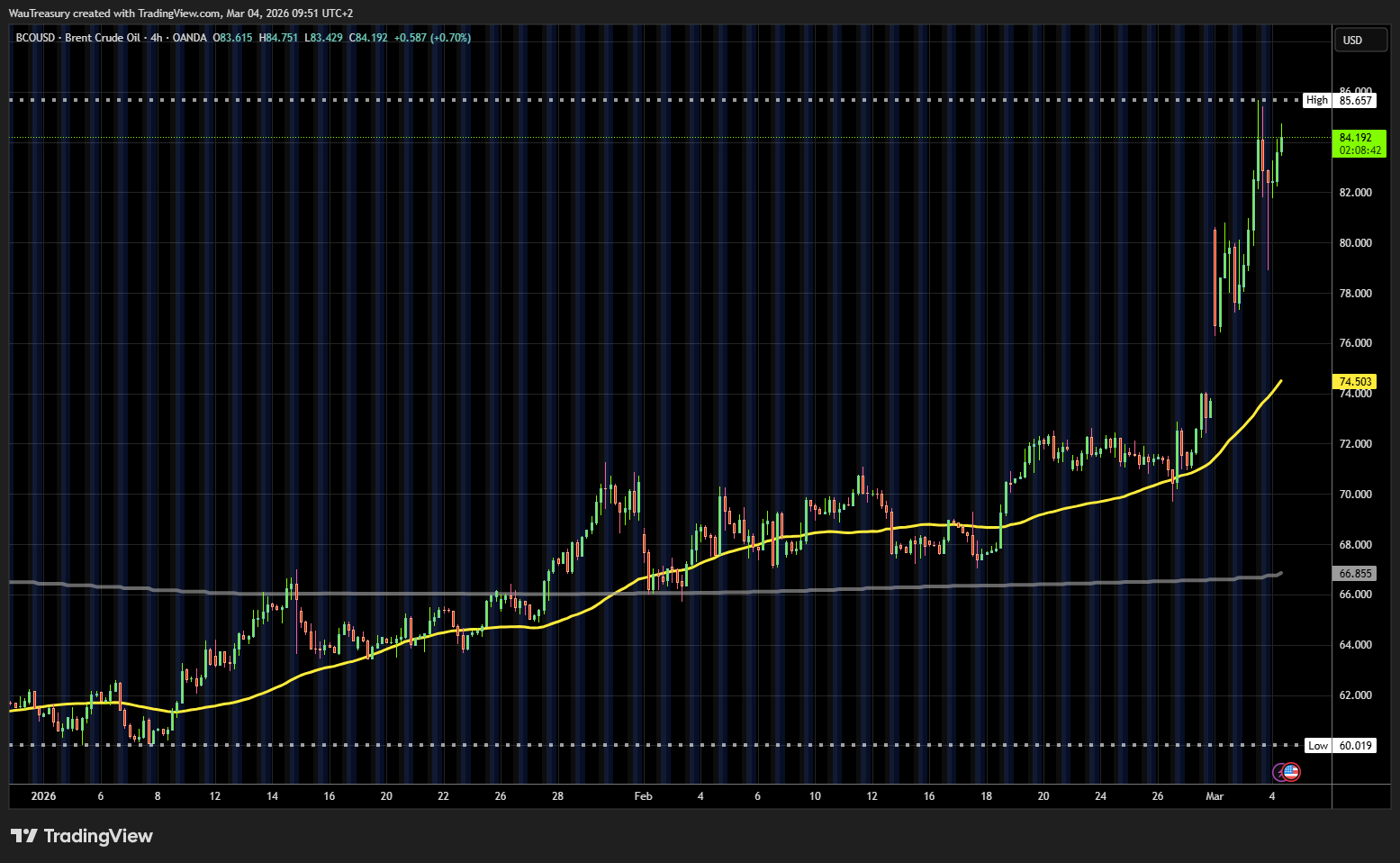
- The Energy Drag (Brent Crude): Physical threats to the Strait of Hormuz act as a direct catalyst for global oil prices. Brent Crude has pushed robustly past the $83 per barrel mark. As a net importer of oil, a sustained energy spike hits South Africa immediately, widening the current account deficit and importing a fresh wave of inflation.
It is worth noting that persistent inefficiencies within the Transnet rail and port networks cap the volume of commodities South Africa can physically export, meaning the country cannot fully capitalise on any renewed safe-haven commodity boom.
XAU/USD (Gold Spot) as of 04 March 2026
XPT/USD (Platinum Spot) as of 04 March 2026
BCO/USD (Brent Crude Spot) as of 04 March 2026
Central Bank Divergence and the SARB’s Dilemma
This geopolitical crisis crashes into an already complex global monetary environment, completely erasing hopes for near-term domestic interest rate cuts. While domestic headline inflation had cooled to 3.5%, this was heavily aided by a deflationary petrol rate of roughly -10%.
This low base effect is now a massive vulnerability. With an under-recovery on the petrol price already sitting at 75 cents a litre, the combination of ZAR weakness and spiking crude creates severe upside risk. Furthermore, a new nationwide foot-and-mouth disease (FMD) outbreak threatens to drive up domestic protein costs.
As a result, forward-rate agreements are now pricing in a 24% chance of a 25-basis-point rate hike at the upcoming March 26 policy meeting. If a sustained Brent Crude spike forces the US Federal Reserve into a “higher-for-longer” stance, the SARB will be forced to adopt a highly conservative approach to protect the currency and anchor inflation expectations.
Looking Ahead: Key Risk Vectors for the Rand
- The Oil-Inflation-Fed Nexus: The most immediate external risk is the trajectory of Brent Crude.
- Secondary Sanctions Anxiety: Investors are increasingly wary of potential secondary US sanctions against South Africa.
- Whipsaw Volatility: The rand is uniquely exposed to sudden headline-driven swings.
- Technical Battle Lines: A break above 16.80 could trigger further depreciation, while support sits around 16.30.
The Bottom Line
The credibility of Budget 2026 provided the rand with a critical fundamental floor, but domestic fiscal discipline cannot insulate the currency from a global geopolitical shock of this magnitude.
As the market transitions from pricing in a transient event to a protracted conflict, the ZAR is uniquely exposed to both the US dollar’s safe-haven supremacy and the severe reflationary threat of surging energy prices.
For corporate treasuries, the grace period afforded by February’s optimism is now a distant memory. March demands a ruthless reassessment of FX exposures; therefore, having a formalised forex policy in place will favourably suit clients to navigate unpredictable and unprecedented market moves.
