
The Fed Held Rates, but the Market Tightened Anyway: Implications for the Dollar, Yen and Rand
Last month, we described USD/JPY as one of the global FX market’s most useful pressure gauges, even for South African businesses with no direct yen exposure. The currency pair provided insight into dollar strength, carry-trade demand, intervention risk and broader investor appetite for emerging-market assets.
This month, the pressure has shifted closer to the centre of the global financial system: the U.S. Federal Reserve.
The Fed’s July decision to leave interest rates unchanged was not simply another routine policy hold. It raised questions about how the central bank will respond to persistent inflation, how Chairman Kevin Warsh intends to communicate with markets and whether investors remain confident in the Fed’s willingness to take unpopular decisions when necessary.
These questions matter to South African businesses because confidence in the Federal Reserve influences the dollar, global bond yields, commodity prices and demand for emerging-market assets. In turn, each of these factors affects the rand.
Why The July Decision Was Unusual
The Federal Open Market Committee voted 9–3 to maintain the federal funds target range at 3.50%–3.75%, with three members preferring an immediate 25-basis-point increase.
The important point is that the disagreement was not between policymakers wanting to cut rates and those wanting to hold. Three members believed that monetary policy needed to become more restrictive.
This created a straightforward question for investors: if U.S. economic activity remains solid, the labour market is stable and inflation is still above the Fed’s 2% target, what exactly is the central bank waiting for?
There was a reasonable argument for patience. Headline inflation had eased, partly because of lower energy prices, while some underlying measures had also improved. Monetary policy works with a delay, meaning the full effect of previous interest-rate increases may still be passing through the economy.
However, the inflation problem has not disappeared. Tariffs, geopolitical tensions, volatile oil prices and resilient demand continue to create upside risks. One encouraging inflation release is not necessarily enough to confirm that price pressures are under control.
The concern was therefore not only that the Fed decided against a hike. It was that Warsh offered limited guidance on what would cause the central bank to act at a future meeting.
Less Forward Guidance, More Uncertainty
Warsh has deliberately reduced the Fed’s reliance on forward guidance. His view is that financial markets should respond more directly to economic data, rather than constantly trying to anticipate the central bank’s next move.
There is some logic to this approach. Excessive guidance can trap policymakers when conditions change and may cause investors to focus more on central-bank wording than on economic fundamentals.
However, there is an important difference between avoiding false precision and leaving markets uncertain about the Fed’s basic reaction function.
Investors do not necessarily need the Fed to promise a rate increase on a particular date. They do, however, need to understand how policymakers are likely to respond if inflation remains above target, oil prices rise further or the labour market continues to show limited signs of weakness.
Warsh has repeatedly stated that the Fed remains committed to returning inflation to 2%. The July meeting nevertheless provided little clarity on the conditions that would trigger another hike.
That uncertainty became most visible in the bond market.
The Bond Market Delivered Its Own Verdict
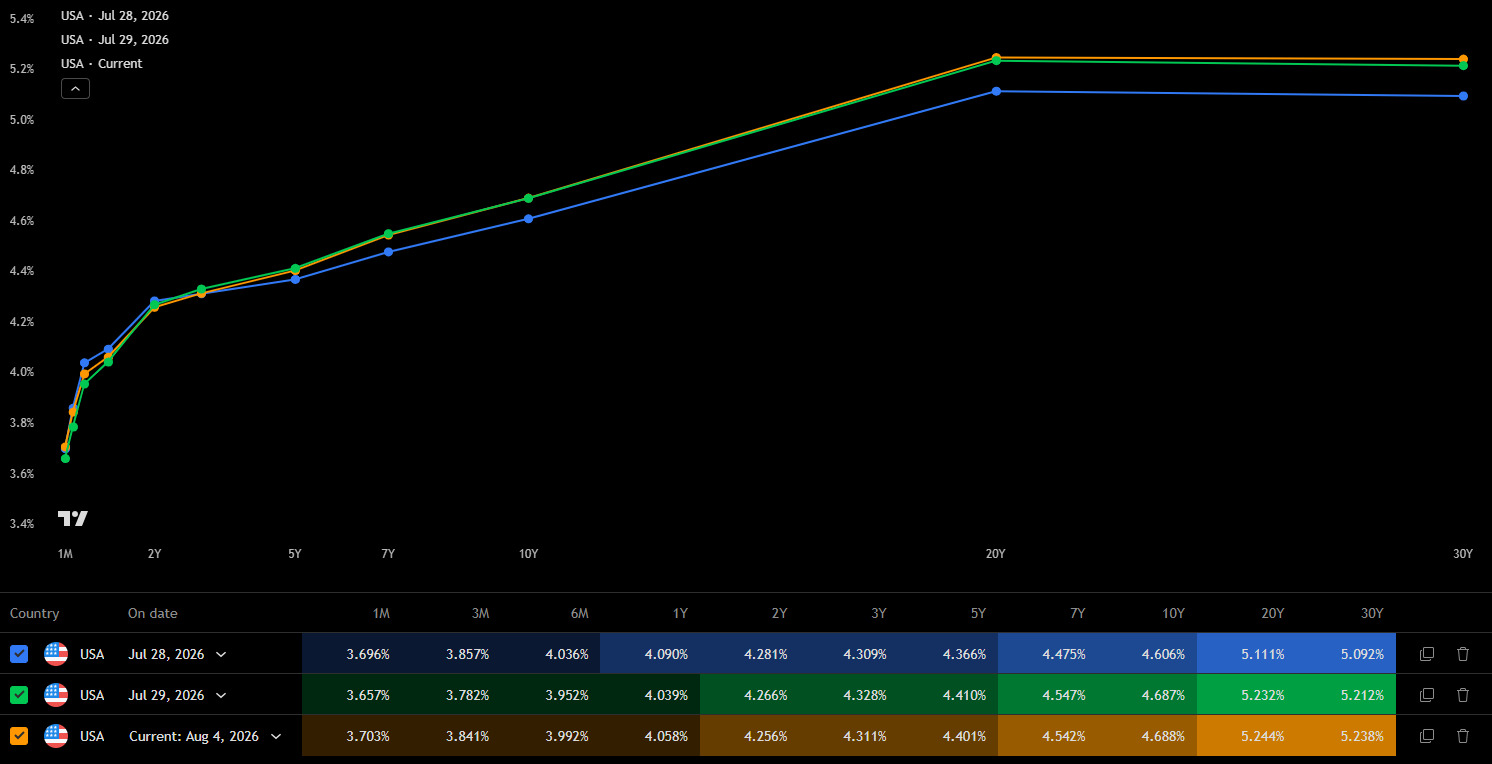
A conventionally dovish Fed decision would normally push both short- and long-term bond yields lower. Instead, the U.S. yield curve steepened sharply following the meeting.
Shorter-dated yields remained relatively contained, reflecting lower expectations of an immediate rate increase. Longer-term yields, however, moved materially higher, with the 30-year Treasury yield reaching its highest level in almost two decades.
This suggested that investors were becoming less concerned about an immediate Fed hike and more concerned that delayed action could allow inflation to remain higher for longer.
In simple terms, the bond market appeared to be saying:
The Fed may be keeping its policy rate unchanged, but investors will demand higher long-term interest rates until they are convinced inflation will be controlled.
This is an uncomfortable form of monetary tightening. Mortgage rates, corporate borrowing costs and government funding costs can all rise even though the central bank has not formally changed its policy rate.
The Fed held rates, but the market effectively tightened financial conditions on its behalf.
The yield curve below compares the market immediately before the Fed’s decision on 28 July, after the announcement and press conference on 29 July, and as at 4 August 2026. Between 28 July and 4 August, the two-year yield declined slightly from 4.28% to 4.26%, while the 30-year yield rose from 5.09% to 5.24%. The gap between the two maturities therefore widened by approximately 17 basis points.
This steepening reflected lower expectations of an immediate hike, but greater concern about longer-term inflation and policy uncertainty.
U.S. Treasury yield curve before and after the July Federal Reserve decision
A Question Of Independence — And Perception
The July decision does not prove that Warsh or the Federal Reserve acted under political instruction.
President Donald Trump has repeatedly called for lower interest rates and criticised the Fed. However, the central bank did not deliver the rate cuts requested by the administration; it simply chose not to hike.
Nevertheless, central-bank independence is partly about perception.
When a president is openly demanding easier monetary policy, inflation remains above target and three policymakers vote for tighter policy, a decision not to hike will inevitably receive greater scrutiny.
The concern is not necessarily that the White House instructed the Fed to keep rates unchanged. Rather, investors may begin to question whether the central bank would be willing to take an unpopular decision if tighter policy conflicted with the administration’s economic or political objectives.
That distinction is important. There may be no direct evidence that the Fed has lost its independence, but markets can still begin pricing a credibility premium into the dollar and U.S. bond market.
Once confidence weakens, verbal assurances become less effective and investors may demand clearer evidence that the Fed remains committed to controlling inflation.
What Are The Implications For The Dollar
A perceived deterioration in Federal Reserve credibility does not necessarily mean that the dollar will collapse.
Lower expectations for short-term interest rates can initially weaken the dollar, particularly against developed-market currencies. At the time of writing, futures markets were pricing in approximately a 63% probability of a 25-basis-point hike in September. A further increase in those expectations could restore some support to the greenback.
Rising long-term Treasury yields may also support the dollar by increasing the prospective return available on U.S. assets. However, the reason yields are rising matters.
Higher yields driven by stronger economic growth would ordinarily be constructive for the dollar. Higher yields driven by persistent inflation, a rising risk premium or concerns about the Fed’s credibility are less clearly positive.
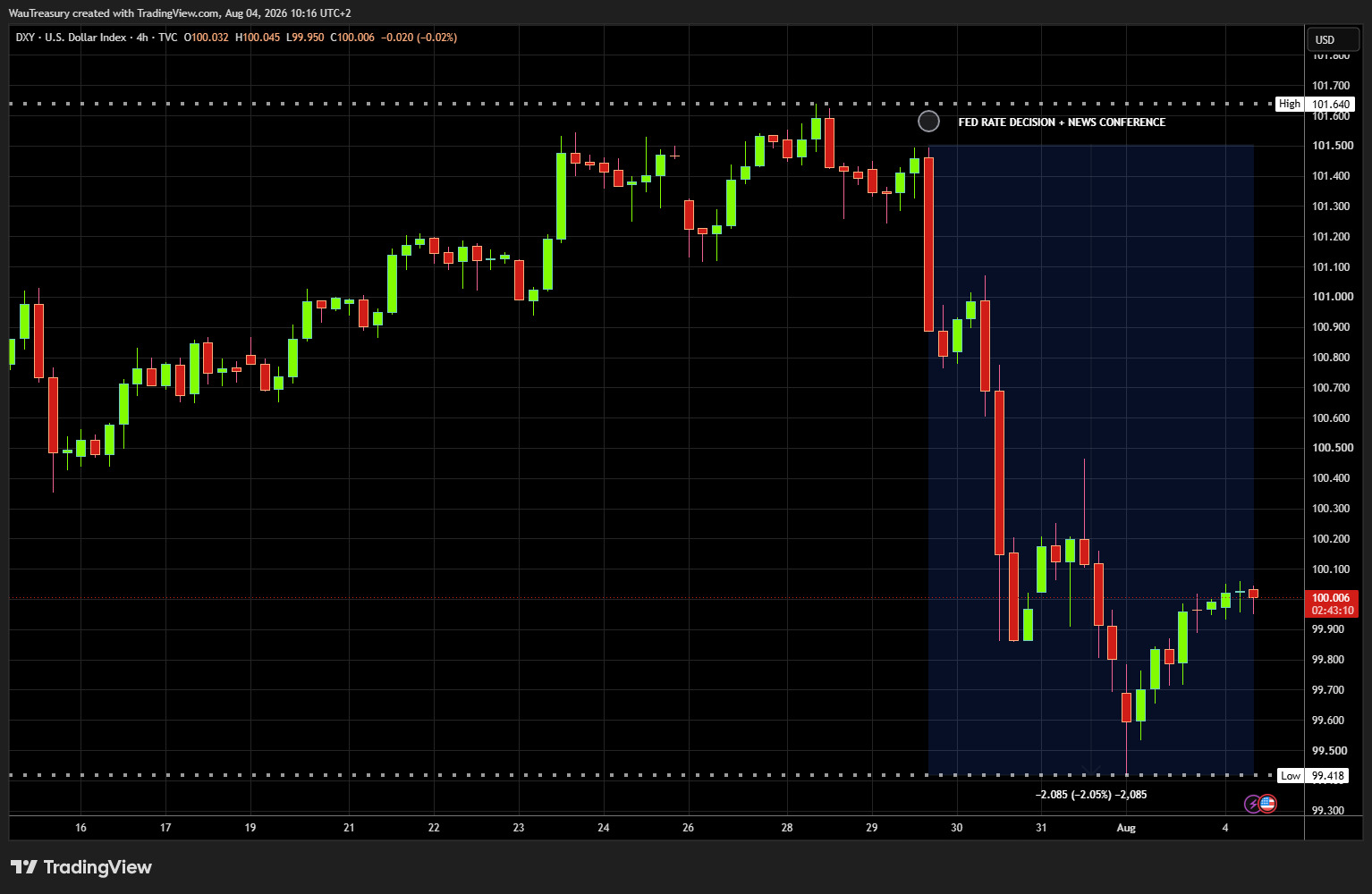
It is therefore notable that the dollar remained on the back foot as markets scrutinised the Federal Reserve’s credibility under Warsh, even while longer-term yields moved higher.
Higher Treasury yields can also tighten global financial conditions, weaken risk appetite and reduce demand for emerging-market assets. This creates a complicated environment in which the dollar may weaken against developed-market currencies such as the yen while remaining supported against higher-risk currencies such as the rand.
The DXY dollar index may therefore not provide the full picture. The source of the dollar’s movement matters. A decline driven primarily by yen strength has different implications for emerging markets than a broad reduction in confidence in U.S. assets.
DXY Index Following US Interest Rate Decision
JPY Intervention and U.S. Involvement
The yen added another source of uncertainty after Japan and the United States intervened to support the currency as USD/JPY approached ¥164.
The pair subsequently fell towards ¥155, representing a decline of approximately 5.3% from its recent highs. The speed and scale of the move demonstrated the immediate power of coordinated intervention and warned traders that continuously betting against the yen now carries greater risk.
U.S. involvement was particularly significant. Japan has intervened independently before, but the impact has often proved temporary because the underlying interest-rate differential remained in place. American participation sent a stronger signal that rapid yen depreciation was increasingly being viewed as a broader financial-stability concern, rather than solely a Japanese issue.
The wider market implications are mixed. A stronger yen places downward pressure on USD/JPY and can weaken the DXY. However, a rapid yen recovery can also force investors to unwind carry trades funded in yen.
These reversals can increase volatility across equities, bonds and emerging-market currencies. As a result, a sharp decline in USD/JPY should not automatically be interpreted as positive for the rand.
Intervention may slow yen weakness and discourage one-sided speculation, but a lasting reversal will still depend on whether the interest-rate gap between Japan and the United States narrows.
USDJPY Following Sharp Rounds of Intervention

What Does This Mean for the Rand?
For the rand, the signals remain conflicting.
A weaker dollar may provide some support, particularly while South Africa’s interest-rate differential remains attractive. However, rising long-term U.S. yields increase the return investors can earn on dollar assets without accepting emerging-market risk.
A rapid carry-trade unwind could also weaken global risk appetite and place pressure on higher-beta currencies. Oil remains another important factor, as South Africa is a net oil importer. Lower Brent prices would ease pressure on inflation and the import bill, while renewed geopolitical escalation and higher oil prices would create additional risks for the rand.
South African businesses should therefore avoid interpreting a Fed hold, a weaker DXY or a decline in USD/JPY as an automatic signal of rand strength. The cause of the market move matters just as much as its direction.
Importers and exporters should continue to hedge progressively according to an approved FX policy, rather than making an all-or-nothing decision around a single central-bank meeting.
The Bottom Line
The Federal Reserve kept its policy rate unchanged, but markets did not interpret the decision as an all-clear signal. Long-term yields rose, the dollar weakened and questions surrounding the Fed’s credibility increased. At the same time, coordinated intervention in the yen introduced another source of potential market volatility.
The result is a less predictable environment in which dollar weakness does not necessarily translate into rand strength.
The Fed may have held rates, but the market tightened anyway. For corporate treasurers, understanding what is driving the move is now as important as the direction of the move itself.
